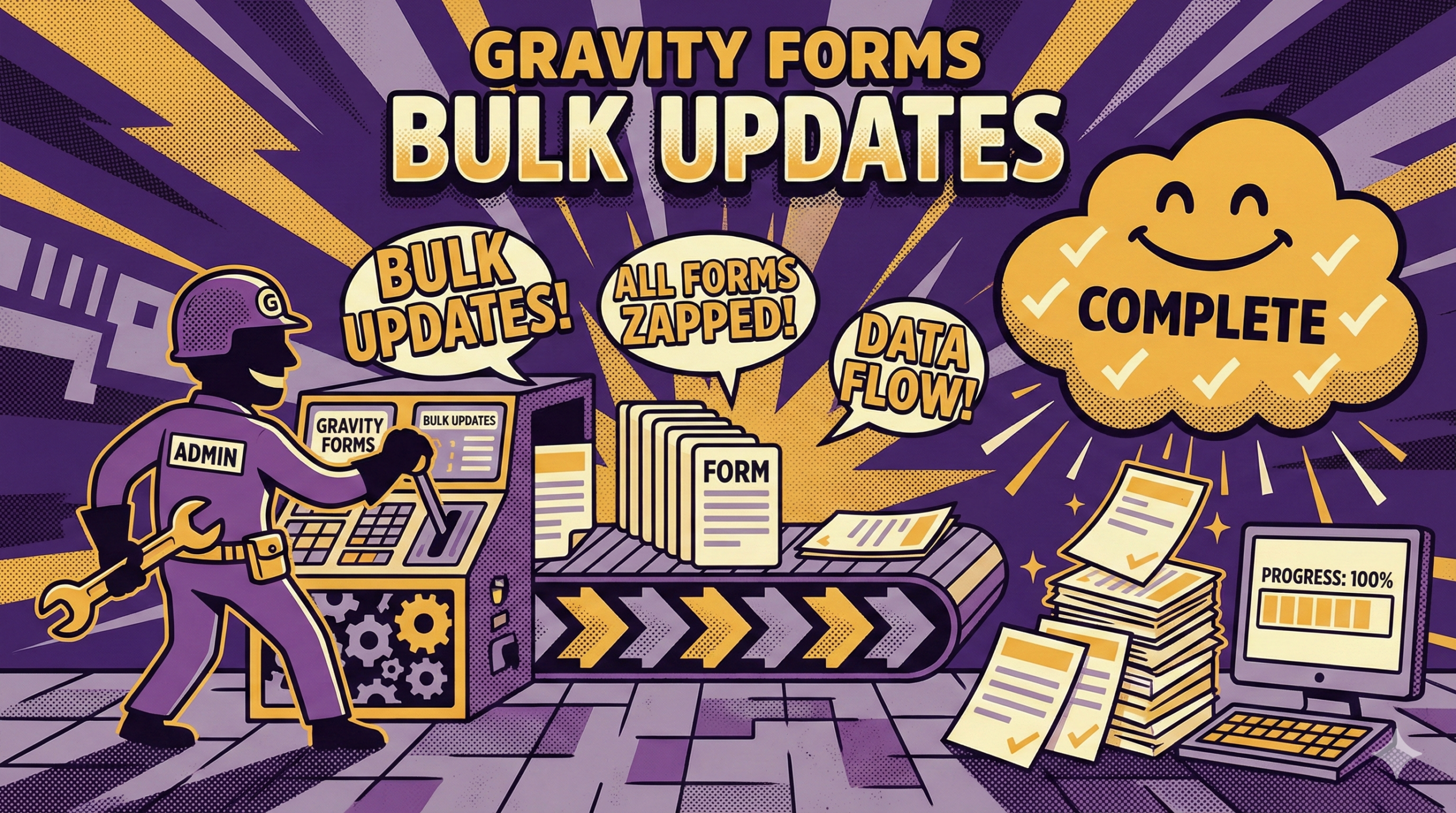
Many businesses send the same update to large groups of people. Status notices. Schedule changes. Policy updates. Process announcements. The sending itself is rarely the hard part. The difficulty shows up earlier, when deciding who should receive which update and who should not.
That decision depends entirely on the data already on file. If recipient records are inconsistent, incomplete, or loosely structured, bulk updates turn into a manual sorting exercise. Someone exports a list. Someone filters it by hand. Someone double checks edge cases. The update gets delayed, or worse, sent to the wrong audience.
This problem does not start when the update is written. It starts at intake. Businesses that rely on Gravity Forms to collect information are already solving a large part of this problem, often without realizing it. The way Gravity Forms captures data creates the conditions that make bulk updates manageable at scale.
Bulk Updates Depend on Structured Recipient Data
Bulk updates only work when recipients can be grouped reliably. That grouping depends on shared attributes that are captured the same way across records.
Consider what usually determines whether someone should receive an update:
- Enrollment status
- Location
- Program type
- Service tier
- Application stage
- Eligibility flag
- Date based thresholds
If those attributes exist as free text, every bulk update becomes a judgment call. One record says “NY.” Another says “New York.” A third says “NYC.” Someone has to interpret that difference before sending anything. The risk increases as the list grows.
When attributes are missing, the situation gets worse. A sender is forced to choose between excluding recipients who should have been included or including recipients who should not have received the message. Both outcomes damage trust.
Bulk updates fail when recipient data cannot be trusted at scale. They succeed when records are predictable enough to support decisions without manual review. That predictability is not created at send time. It is created when the data is collected.
Gravity Forms Creates Predictable Records by Design
Gravity Forms enforces structure at the moment information enters the system. That constraint matters more for future updates than for the initial submission itself.
Every form is built from defined fields. Each field accepts a specific type of input. Text fields behave differently from dropdowns. Checkboxes behave differently from radio buttons. Date fields behave differently from number fields. These constraints prevent variation from creeping into the dataset.
Required fields enforce completeness. If a field is necessary to classify a recipient later, Gravity Forms can require it before submission. That prevents records from entering the system without the attributes needed to manage them downstream.
Choice based fields limit drift over time. When recipients select from predefined options, the values remain consistent across months or years. The dataset does not accumulate alternate spellings or improvised labels. Grouping remains possible long after the form was created.
This structure has an operational effect. It allows bulk updates to rely on recorded attributes rather than interpretation. The sender does not need to remember how a question was phrased last year or how a previous staff member labeled responses. The form enforced the structure when the data was captured.
Gravity Forms does not solve bulk updates directly. It solves the prerequisite. It produces records that behave consistently when filtered, grouped, or reviewed.
Conditional Collection Keeps Records Complete Without Noise
One of the risks in designing intake for bulk updates is over collection. If every recipient is asked every question, forms become long, and completion rates drop. If too few questions are asked, records lack the information needed to segment recipients later.
Gravity Forms addresses this through conditional logic. Fields appear only when relevant conditions are met. A recipient provides additional information only when it applies to their situation.
This has two important effects on bulk updates.
First, it keeps records complete within their category. If a recipient belongs to a group that requires extra attributes, those attributes are collected at intake rather than chased later. The record contains what is needed to evaluate inclusion in future updates.
Second, it avoids polluting the dataset with irrelevant fields. Records remain focused on attributes that actually apply. This makes grouping more reliable because the presence or absence of data carries meaning.
For example, a field that appears only for a specific program creates a natural segment. Every record with that field populated belongs to the same category. Every record without it does not. No additional interpretation is required.
Conditional collection supports bulk updates by preserving signal. Records contain what matters, when it matters, and avoid accumulating unused fields that complicate later decisions.
Conclusion
Bulk updates succeed when recipient data supports confident decisions. That support is established long before any update is drafted or sent. It is established at intake, when records are created.
Gravity Forms enables this by enforcing structure, completeness, and relevance at the moment information is captured. Fields constrain variation. Required inputs prevent gaps. Conditional logic ensures that records contain the attributes needed to group recipients accurately.
Businesses that send updates in bulk often focus on the sending process. The real leverage sits earlier. When recipient data is predictable, bulk updates stop feeling risky or labor intensive. They become routine operations supported by records that already do the sorting work.
Gravity Forms does not turn businesses into broadcasters. It turns intake into a stable foundation. When that foundation is in place, bulk updates stop being a problem to solve and start being a process that runs as expected.
Want to learn more about Gravity Forms? Reach out to BrightLeaf Digital today!
Check out our Snippets Library for useful additions to your Gravity Forms workflow.