
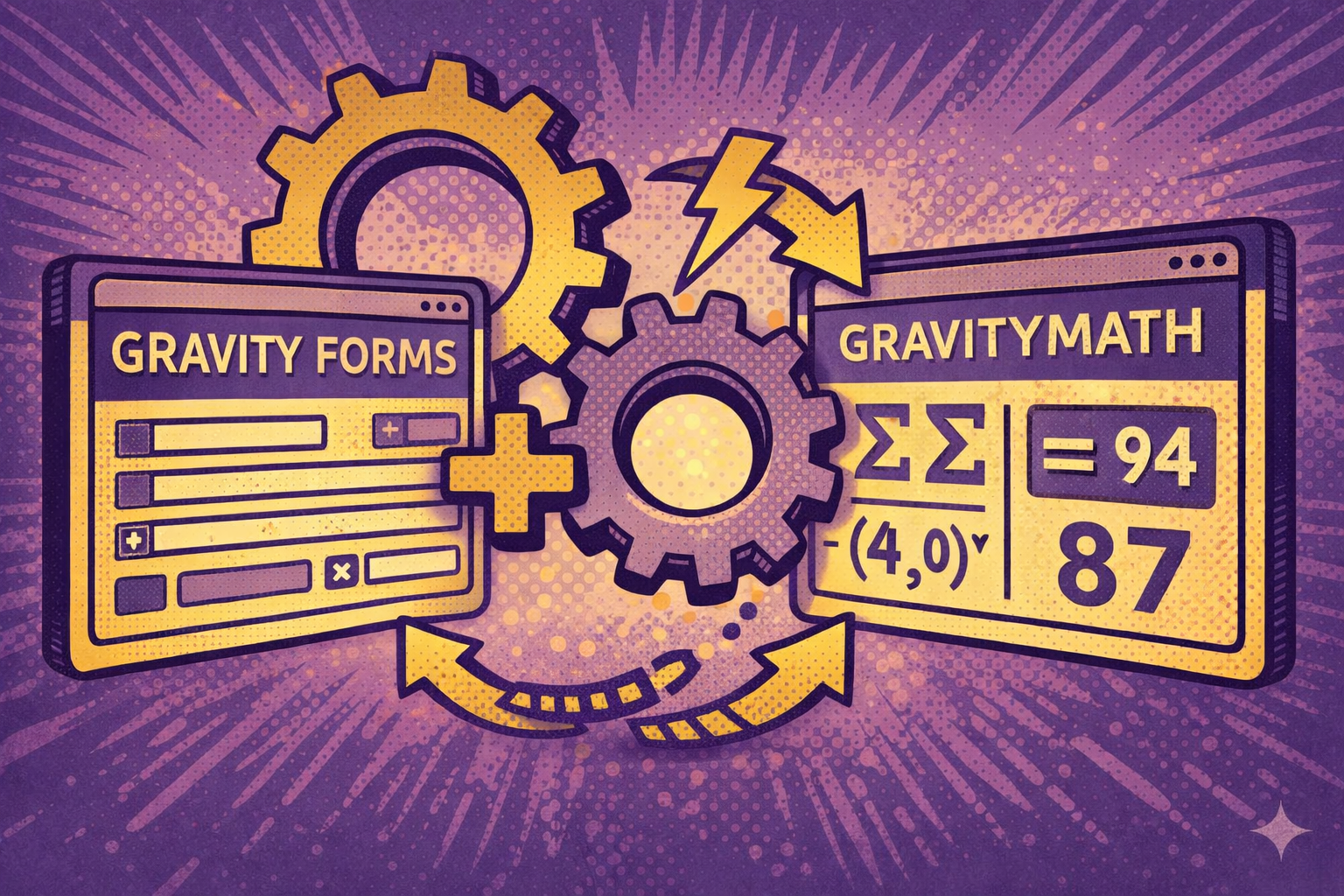
GravityMath was designed specifically to work with Gravity Forms, and the real value of that design choice shows up when you design and use them as a unified system instead of two separate tools.
That mindset changes how you approach building anything serious with forms. Not because it introduces new mechanics, but because it reframes what forms and calculations are meant to do together.
- Gravity Forms collects information in a structured way.
- GravityMath calculates derived values from that information.
When those two roles are treated as one, the work moves from collecting data first and interpreting it later to collecting data with clear interpretation already in view.
This difference is subtle, but it has wide implications for how far you can push Gravity Forms before you feel pressure to rely on external tools just to understand what your entries are telling you.
Forms Create Information and Calculations Create Interpretation
At a basic level, forms are about inputs.
- Questions are asked.
- Answers are submitted.
- Entries are stored.
By themselves, those answers are raw. They describe what someone entered, but they do not automatically express totals, comparisons, thresholds, or summaries.
Calculations add that layer. They define how answers relate to each other. They turn multiple inputs into a single result that you can reference consistently. For example, they can express:
- Totals
- Averages
- Differences
- Ratios
- Other derived values that explain what an entry represents
Gravity Forms and GravityMath were built with this division of responsibility in mind.
- Gravity Forms excels at capturing structured data.
- GravityMath exists to evaluate formulas against that data and output the results where you need them.
Neither replaces the other. Each becomes more useful when the other is present.
When you treat them as one system, you stop thinking of calculations as an afterthought that lives in a spreadsheet or a separate reporting layer. You start thinking of calculations as part of how entry data becomes useful.
When Forms and Calculations Work Together, Outcomes Are Consistent
The moment calculations are considered during form design, the role of the form shifts.
- It is no longer just a place where data is stored for later review.
- It becomes the place where data is collected with a clear plan for how it will be interpreted.
A form designed alongside its calculations is asking questions with intent.
- Fields exist because they feed specific results.
- Answers are captured because they support known formulas.
That does not mean the form is making decisions on its own. It means the same derived values can be produced reliably when the same data is submitted.
This matters because many operational decisions are not made by reading entries line by line. They are made by relying on derived values:
- Totals inform pricing.
- Scores support prioritization.
- Thresholds support categorization.
- Summaries support reporting.
Even when humans remain the ones making the final call, derived values reduce ambiguity and make the decision surface clearer.
Why This Matters as Your System Grows
Small setups can tolerate a loose relationship between forms and calculations.
- A few forms.
- A few formulas.
- Some manual checking.
At that scale, it is easy to keep everything in your head.
As systems grow, that tolerance disappears.
- More forms often means more repeated logic.
- More repeated logic means more places where formulas need to stay aligned.
Without a deliberate approach, teams often end up recreating the same interpretation in multiple contexts.
Nothing is inherently wrong with that. It is a normal pattern. The issue is what it does to long-term clarity.
- The more places the same logic appears, the harder it becomes to reason about changes.
- Even if the math is correct, the system becomes harder to maintain with confidence.
Treating Gravity Forms and GravityMath as one system changes how growth feels.
- Interpretation stays tied to the data model that produced it.
- You reduce the number of places where meaning has to be recreated from scratch.
Keeping Interpretation Where the Data Lives
A common response to complexity is to move interpretation elsewhere.
- Data is collected in WordPress.
- It is exported to spreadsheets, dashboards, or external services for analysis.
- Calculations live in a different tool.
- Logic gets rebuilt outside the system that produced the entry.
This approach can work well, and external tools can be excellent at reporting. The tradeoff is structural.
- Meaning becomes detached from the source.
- Logic has to be maintained in more than one place.
- Updates require coordination.
- Over time, it gets harder to know whether the numbers you are looking at match the logic your forms currently reflect.
Treating Gravity Forms and GravityMath as one system reduces the need to do that when the goal is simply to interpret your own entry data.
- Calculations run against the entries.
- Results can be displayed wherever you need them in WordPress.
- You do not have to move information out of the system just to produce totals, summaries, or derived values.
This does not eliminate the role of external tools in every scenario. It reduces dependence on them for basic interpretation that can live alongside the source data.
How Far the Synergy Can Take You
Once you adopt this mindset, the ceiling on what you can build with Gravity Forms rises.
For example:
- You can support complex pricing and fee calculations without leaving WordPress.
- You can produce eligibility or scoring outputs that help standardize how entries are evaluated.
- You can generate metrics and summaries from entry data across pages, confirmations, and dashboards.
- You can build views of your data that rely on calculated results rather than manual interpretation.
The key is not advanced math. The key is consistent interpretation.
- You spend less time rebuilding meaning elsewhere.
- You spend less time exporting entries just to do basic calculations.
Gravity Forms provides the structure. GravityMath provides the calculated layer. Together, they make it easier to treat your WordPress system as a place where entry data can be collected and interpreted without immediately leaving the ecosystem.
A Strategic Advantage, Not a Feature Checklist
The advantage of treating Gravity Forms and GravityMath as one system is not a single feature. It is what happens when collection and interpretation are designed together.
Systems that keep interpretation close to the data tend to be easier to operate.
- They reduce manual steps.
- They make reporting more consistent.
- They make it easier to explain what a number represents, because the formula that produced it is tied to the same system that collected the inputs.
This approach also scales more cleanly.
- As requirements change, calculations can evolve alongside your forms.
- Logic does not drift into disconnected external layers.
- The system stays coherent because the same source data and the same calculation logic stay connected.
None of this requires abandoning external platforms that you already use for broader analytics or business intelligence. It simply reframes what should remain inside WordPress when the primary goal is interpreting Gravity Forms entry data.
Treating Them as One Aligns With How They Were Built
GravityMath was built specifically to work with Gravity Forms. Gravity Forms was built to support structured, repeatable processes. Treating them as one system aligns with that reality.
- Interpretation becomes more consistent.
- Entry data becomes more immediately useful.
- You rely less on exporting and reinterpreting data in external tools just to get basic answers.
That shift in thinking is the foundation. Everything else builds on it.
Got more questions about Gravity Forms or GravityMath? Reach out to BrightLeaf Digital and we’d be happy to give you answers.