Most WordPress sites are built “correctly” and still fail operationally.
They have solid design, the right pages, and a decent plugin stack. The copy looks fine. The navigation works. The forms send emails. On paper, everything is set up the way it’s supposed to be.
And yet, the business still runs in a patchwork. Every new requirement becomes a mini-project. Every change creates new edge cases. The team keeps adding tools, adding workarounds, and adding manual steps that nobody loves—but everybody relies on.
In most cases, the problem isn’t WordPress. It’s the mental model people bring into WordPress.
The Page-Centered Trap
WordPress teaches you to think in pages because pages are the most visible part of a website. You plan a home page, an about page, a services page, and a contact page. Then as the business grows, the instinct stays the same: you keep solving operational needs by asking, “What page should this live on?”
That approach works for content. It breaks down when the site becomes responsible for operations.
Because operations don’t primarily live on pages. Operations live in a flow of information: who submitted what, what state it is in now, who needs to act next, and what happens if they don’t.
When your default lens is “page-building,” you end up designing a website that collects data, but doesn’t actually manage it.
Operations Don’t Display Information — They Move It
A website’s job is to present information clearly. That’s important, but it’s only half the story once your site becomes part of how the business runs.
Operational systems aren’t defined by what they show. They’re defined by what they move.
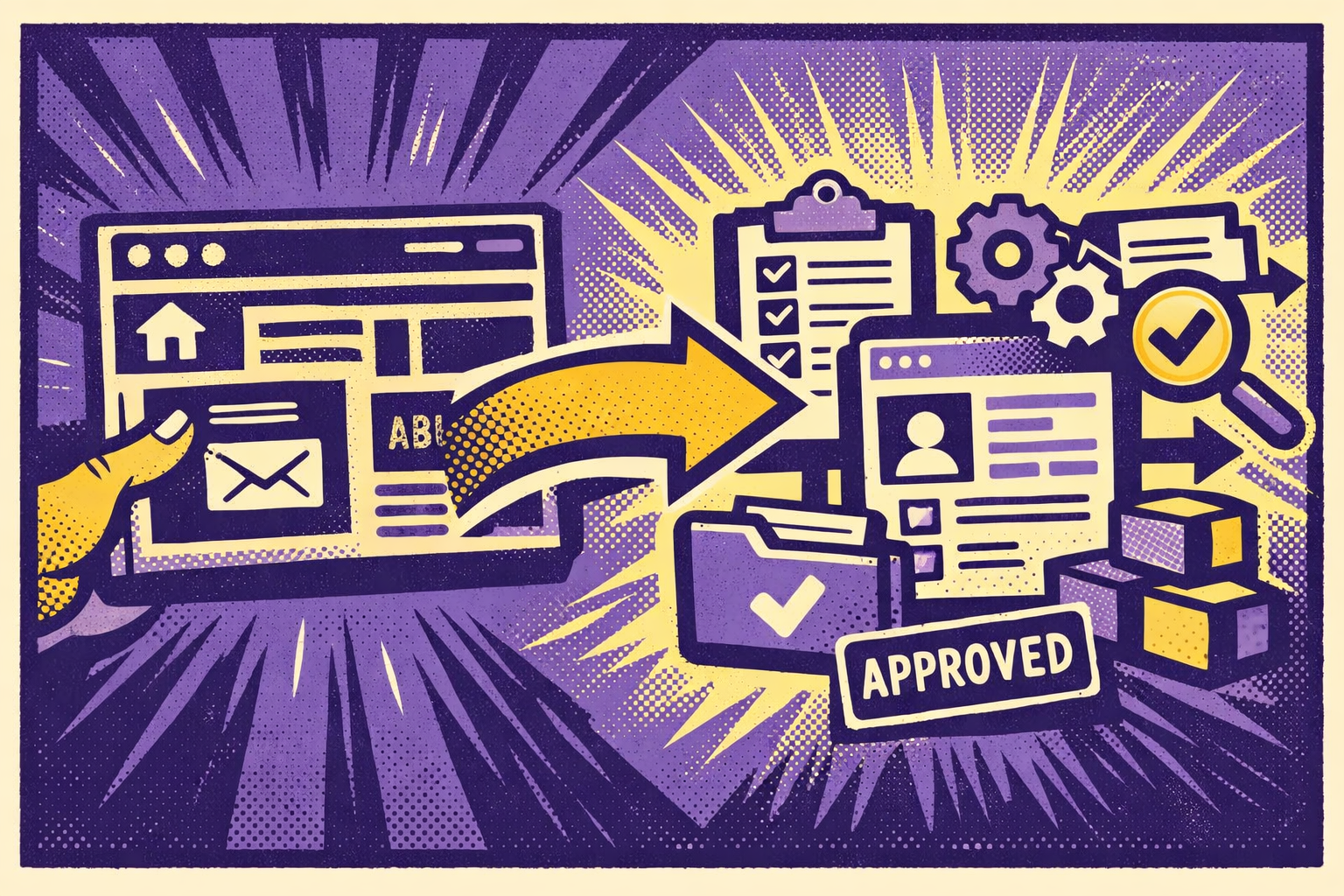
When someone submits a request, applies for something, schedules a call, or fills out an intake, the submission itself is not the outcome. The submission is the beginning of a process that should be trackable and predictable. The system needs to know what that submission is, what it’s waiting on, who owns it, and what “done” actually means.
If a workflow only exists inside someone’s head or inside a chain of emails, then your business logic is running on human memory. That works until it doesn’t.
Forms Are Entry Points, Not Features
Most WordPress users think of forms as features that live on a page. That’s not wrong, but it’s incomplete.
A form is better understood as an entry point into a process. It’s the moment the system starts tracking something that matters.
Once you see forms this way, the questions you ask change immediately. Instead of focusing on where the form sits or how it looks, you start thinking about what the submission represents and what should happen next. You start asking what state gets created, what conditions change that state, and how the system should behave as the record moves forward.
That’s not a technical upgrade. It’s a design upgrade.
Submissions Are Disposable. Records Are Not.
Here’s where most WordPress operations quietly collapse: people treat submissions as if they’re temporary events.
A submission comes in, the site emails someone, and then the rest of the work happens somewhere else. Maybe in spreadsheets. Maybe in project management software. Maybe in Slack. Maybe in a staff member’s inbox. Usually in a mix of all of the above.
Operational systems don’t treat important inputs as disposable. They treat them as records.
A record is something the system can reliably refer back to. It has history. It has ownership. It has a current state. It has a trail of changes. It can be reviewed. It can be audited. It can be handed off cleanly. It doesn’t disappear when an email gets buried.
Once you shift from “submission” to “record,” the site stops being a brochure with a contact form and starts becoming something closer to an internal operating system.
Status Is Not Decoration
In many setups, “status” is just an informational label. People add a field and mark something as New, In Progress, or Done. It helps for visibility, but it usually doesn’t change how the system behaves.
Operational thinking treats status as meaning, not decoration.
Status determines what can happen next. It determines who is responsible. It determines which actions are allowed. It determines what should be blocked. It is the logic that separates “we received this” from “we reviewed this” from “we approved this” from “we completed this.”
When status is just text, humans have to do all the thinking and all the remembering. When status represents state, the system can start enforcing consistency.
That’s the difference between tracking work and running work.
Why More Tools Doesn’t Fix This
When the underlying mental model is page-centered, the natural response to operational problems is to keep adding pieces. Another plugin here. Another integration there. Another admin screen. Another “temporary” automation that becomes permanent.
The result is usually not a system. It’s a pile of parts.
The problem is not that WordPress can’t support operations. The problem is that operations weren’t designed as operations. They were layered onto a website that was never meant to manage state and flow in the first place.
The Actual Shift
The shift isn’t technical. It’s conceptual.
Stop designing pages as the primary unit of work. Start designing processes as the primary unit of work.
Pages are where people see outcomes. Processes are what create outcomes.
Once you start thinking this way, a lot of problems that felt unsolvable in WordPress become much simpler. They stop being “Which tool do I need?” problems and become “What’s the process, and what should the system remember?” problems.
That’s a very different conversation—and it’s the conversation most WordPress users never reach.
What Comes Next
Once you begin seeing WordPress as a place where processes can live—not just pages—your site starts to look less like a marketing artifact and more like operational infrastructure.
And when your infrastructure is designed instead of improvised, everything downstream gets easier: handoffs, visibility, consistency, and scale.
That’s the mental shift. Everything else builds on it.